
A failing radiator fan in your Nissan puts your engine on a fast track to disaster. Without the fan pulling air through the radiator at idle or in traffic, coolant temperatures climb rapidly and can trigger blown head gaskets or total engine seizure. Common warning signs include a rising temperature gauge at stoplights, weak or warm A/C output, and an illuminated Check Engine Light. In Nissan Sentra models, roughly 34% of these failures trace to a dead fan motor, 28% to bad relays or fuses, and 23% to faulty sensors or control modules. The encouraging news is that most causes can be pinpointed and repaired without a massive shop bill if you move quickly.
This guide walks you through a proven diagnostic sequence, from quick fuse checks to advanced voltage drop testing that exposes hidden wiring faults. You will learn how to test the fan motor directly, identify the critical 10V relay issue common to many Nissan models, and decide when a full assembly replacement makes more sense than swapping just the motor. Each step includes real-world specifications and time estimates so you can fix the problem with confidence.
Recognize Overheating Warning Signs Early
Overheating Only at Idle or in Traffic
If your Nissan stays cool on the highway but climbs toward the red zone at stoplights, the radiator fan is the most likely culprit. At higher speeds, ram air through the grille keeps temperatures manageable. Once you stop, the fan must take over, and if it fails to spin, heat has nowhere to escape. This pattern points to an electrical or control failure rather than a coolant leak or stuck thermostat.
A/C Blows Warm Air at a Standstill
The radiator fan pulls air across both the radiator and the A/C condenser. When the fan stops working, the condenser cannot release heat, so the vents push out lukewarm air even with the system on max. If your A/C only struggles when parked or crawling in traffic, and the engine temperature rises at the same time, the fan circuit deserves immediate attention.
Check Engine Light and Diagnostic Codes
A failing fan system commonly triggers the Check Engine Light. Typical trouble codes include P0480 for Cooling Fan Relay 1 Control Circuit, P0115 through P0119 for Coolant Temperature Sensor issues, and P0487 for Fan Speed Sensor faults. Use an OBD2 scanner to pull stored codes. Even without codes, active overheating alone proves the fan is not performing its job.
Test the Fan Motor with Direct Power

Apply 12V Using Jumper Wires
Bypassing the entire control circuit isolates the motor itself. You will need two jumper wires and a 12V source such as your car battery.
- Locate the radiator fan behind the grille.
- Disconnect the fan’s electrical connector.
- Attach one jumper from the battery’s positive terminal to the fan’s positive wire.
- Attach the second jumper from the battery’s negative terminal to the fan’s negative wire.
If the fan spins smoothly, the motor is good and the problem lies upstream in the relay, fuse, wiring, or sensor. If it does not spin, spins erratically, or makes noise, the fan assembly needs replacement.
Listen for Grinding or Rattling
A fan that turns but emits grinding, whining, or rattling sounds likely has worn bearings or damaged blades. Even if direct power makes it spin, internal wear signals early failure. Replace the entire assembly if you hear abnormal noise or spot bent or cracked blades.
Inspect Fuses and Relays First
Locate and Test the Fan Fuse
Start with the simplest and cheapest fix.
- Open the fuse box, typically near the battery or under the hood.
- Identify the radiator fan fuse using the diagram printed on the cover.
- Pull the fuse and inspect the metal strip inside. If it is broken, replace it with a fuse of the exact same amperage.
Warning: If the new fuse blows immediately, stop. A short circuit exists, likely in the fan motor or wiring harness. Repeatedly installing fuses risks an underhood fire.
Swap and Test the Fan Relay
Relays fail frequently and are quick to verify.
- Locate the radiator fan relay in the same fuse box.
- Swap it with a matching relay such as the horn relay.
- Turn the key to ON and switch on the A/C. If the fan runs now, the original relay was bad.
You can also test with a multimeter set to continuity mode. Apply 12V to the relay’s coil pins (85 and 86). You should hear a click and measure continuity across the power pins (30 and 87). No click or no continuity means the relay needs replacement.
Measure Relay Voltage Drop

Watch for 10V Instead of 12V
Many Nissan models, including the 2015 Sentra, exhibit a well-documented flaw where the fan relay receives only 10V instead of the required 12V. This voltage is too weak to close the relay contacts, even when the relay itself is perfectly functional.
Test it with a multimeter:
- Back-probe the relay’s control pin, usually pin 85 or 86, while the fan should be active (engine hot or A/C running).
- Measure voltage at the pin.
Interpret the results as follows:
- 12V: Relay should activate. If it does not, replace the relay.
- 10V or less: High resistance in the control circuit. Inspect for corroded wires, loose connectors, or bad grounds between the ECM and relay.
- 0V: No signal from the control module. Check the IPDM or ECU.
Diagnose the Control Module and Sensors

Run the IPDM Self-Test
The Integrated Power Distribution Module (IPDM) commands the fan in most modern Nissans and can fail without warning.
To activate the self-test:
- Turn the ignition OFF.
- Press and hold the IPDM test button if equipped, or follow the key-cycle sequence listed in your service manual.
- Turn the key to ON without starting the engine.
- The fan should run for about 30 seconds regardless of engine temperature.
If the fan runs, the IPDM is functional and the problem likely involves a sensor. If the fan does not run, the IPDM may be faulty or lack proper power supply.
Test the Coolant Temperature Sensor
The CTS tells the ECM when to switch on the fan. A failed sensor means the fan never receives the activation signal.
Symptoms of a bad CTS include:
- Engine running rich with black exhaust and poor fuel economy
- Fan never turning on
- Overheating without warning
Test with a multimeter:
- Unplug the CTS, usually located near the thermostat housing.
- Measure resistance across the terminals.
- Compare to expected values:
* Cold engine: approximately 2,000 to 3,000 ohms
* Hot engine: approximately 200 to 300 ohms
Resistance that is far outside these ranges or reads as open (infinite) means the sensor needs replacement.
Inspect Wiring and Connectors Thoroughly
Find Corroded or Chafed Wires
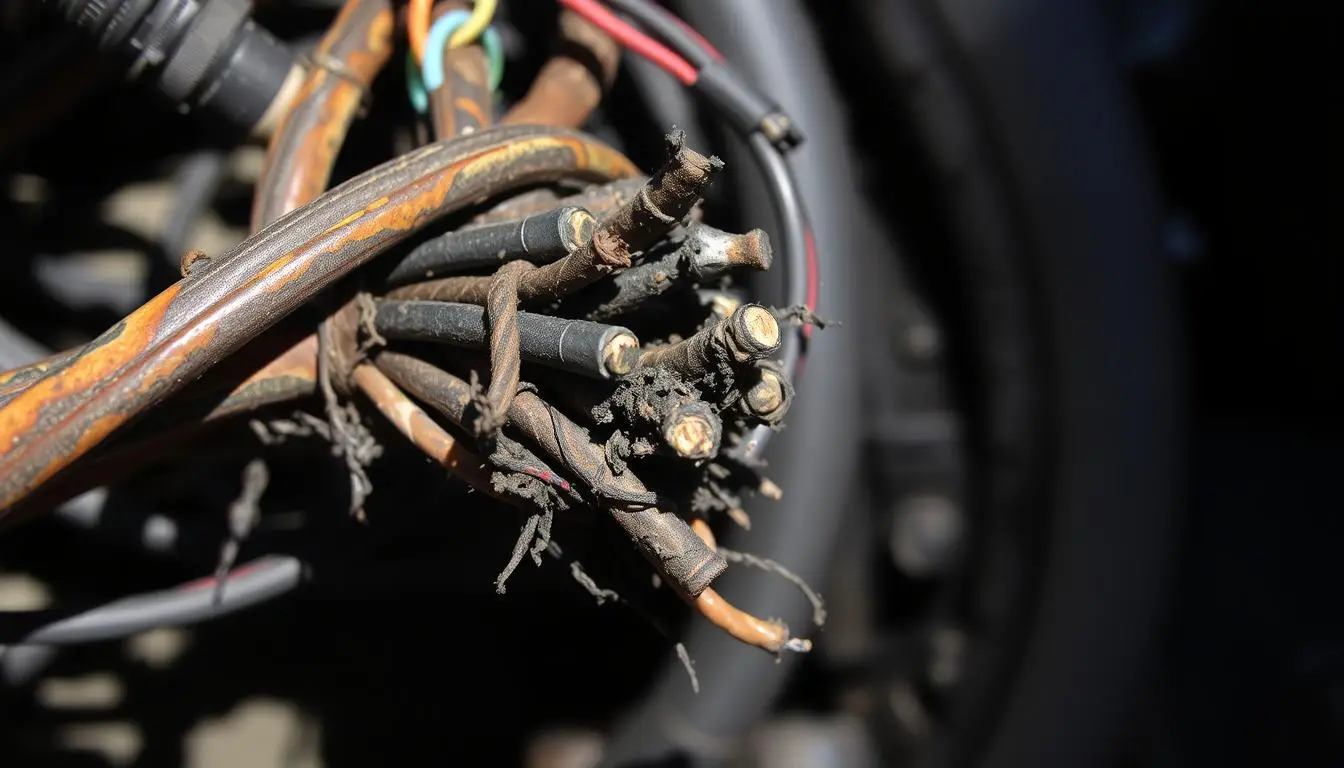
Wiring degradation is a hidden cause in many Nissans. The ECM sends a 12V signal to the relay coil, and any resistance along the path drops that voltage to 10V, enough to register on a meter but not enough to activate the relay.
Inspect these critical areas:
- Harness near the battery for acid corrosion
- Wires routed along the firewall for heat damage
- Connectors at the IPDM, ECM, and fan relay
Look for green or white corrosion on terminals, brittle or melted insulation, and loose pins inside connectors.
Repair Wiring the Right Way
Never use twist-on connectors under the hood. The best repair method is:
- Cut out the damaged wire section.
- Solder a new wire in place.
- Seal the joint with heat-shrink tubing.
- Apply dielectric grease to connectors before plugging them back in.
This combination blocks moisture and prevents corrosion from returning.
Replace the Fan Assembly or Motor
Decide Between Motor Only and Full Assembly
Some aftermarket kits let you swap just the motor, but most mechanics and Nissan dealerships recommend replacing the entire fan assembly. The reasons include:
- Proper blade balance out of the box
- No future mounting headaches
- New wiring pigtail included
- Reduced chance of comeback repairs
Cost: $286 to $419 for parts and labor.
Time: 1 to 2 hours.
Pro tip: Choose OEM or high-quality aftermarket fans. Cheap units fail faster and draw excess current, which can blow fuses and damage relays.
Prevent Future Fan Failures
Clean the Fan and Radiator Regularly
Dirt, bugs, and road debris block airflow and force the fan to work harder and run hotter. Clean the radiator fins and fan blades every six months, especially if you drive on dusty or unpaved roads.
Monitor the A/C and Temperature Gauge
Use this quick A/C test at idle:
- Turn the A/C to maximum.
- You should hear the fan engage within 30 seconds.
If you hear nothing, investigate immediately before temperatures spike.
Use Dielectric Grease on Every Connector
Whenever you replace a cooling system component, apply dielectric grease to every electrical connection. It seals out moisture and prevents oxidation, extending the life of sensors and relays.
When to Visit a Professional Mechanic
If you have replaced the fuse and relay, confirmed 12V at the relay coil, and tested the fan motor with jumper wires, yet the fan still refuses to run, the issue may be deeper than a DIY repair can handle:
- Failed IPDM (expensive and often requires programming)
- ECM software glitch
- Complex wiring harness damage
A qualified Nissan technician with a factory scan tool can force fan activation, read live CTS data, and trace control signals with precision.
Frequently Asked Questions About Nissan Radiator Fan Problems
Why does my Nissan overheat only at idle?
At idle there is no ram air through the radiator, so the electric fan must handle all cooling. If the fan motor, relay, or control circuit fails, heat builds with nowhere to go. On the highway, forward airflow compensates for the missing fan and temperatures stay normal.
Can a bad radiator fan cause the Check Engine Light?
Yes. The ECM monitors cooling performance and triggers codes such as P0480, P0487, or P0115 through P0119 when the fan circuit malfunctions. Even without a stored code, severe overheating alone can illuminate the Check Engine Light.
How do I know if my fan relay is bad?
Swap it with a matching relay like the horn relay and turn on the A/C. If the fan now runs, the original relay was faulty. You can also apply 12V directly to the relay coil and listen for a click while checking for continuity across the power pins.
What is the 10V relay problem in Nissan vehicles?
Many Nissan models, including the 2015 Sentra, show only 10V at the relay control pin instead of the required 12V. This voltage drop is caused by high resistance in the wiring or connectors between the ECM and the relay. The relay cannot close at 10V, so the fan never runs even though the relay itself is good.
Should I replace just the fan motor or the whole assembly?
Most professionals recommend replacing the complete fan assembly. It ensures proper blade balance, includes a fresh wiring pigtail, and avoids future mounting issues. Motor-only kits exist but often lead to vibration or premature failure.
How much does it cost to fix a Nissan radiator fan?
Repair costs depend on the failed component. Replacing a fuse or relay costs only a few dollars. A full radiator fan assembly replacement typically runs $286 to $419 for parts and labor. Complex repairs involving the IPDM or wiring harness can exceed $500.
Key Takeaways for Fixing Your Nissan Radiator Fan

Start every diagnosis with the simplest checks: inspect the fuse, swap the relay, and apply direct 12V to the fan motor. If the motor spins, move upstream and measure voltage at the relay control pin, watching carefully for the 10V drop that fools many DIYers. A reading below 12V almost always points to corroded wiring or loose connectors rather than a bad relay.
When replacement becomes necessary, invest in a quality OEM or reputable aftermarket fan assembly to avoid repeat failures. Apply dielectric grease to every connector and clean the radiator fins regularly to extend the life of the new components. If electrical tests all pass and the fan still refuses to run, hand the job to a Nissan specialist with the proper scan tools to diagnose the IPDM or ECM.
Acting quickly protects your engine from catastrophic overheating and saves you from repair bills that can climb into the thousands. Diagnose today, repair this week, and keep your Nissan running cool for years to come.