Yes, coolant does run through or around the EGR valve, but only in vehicles equipped with water-cooled EGR systems. In these setups, coolant circulates through sealed passages in the valve housing or an integrated EGR cooler, helping lower exhaust gas temperatures before the gases re-enter the engine. This design is common in modern diesel and turbocharged gasoline engines built to meet strict emissions standards.
This article explains exactly how coolant interacts with your EGR system, what happens when it leaks, and how to diagnose and fix problems before they cause serious engine damage.
Water-Cooled vs. Air-Cooled EGR Systems
Water-Cooled EGR: Standard in Modern Engines
In water-cooled EGR systems, coolant flows through a heat exchanger called the EGR cooler, which is either built into the EGR valve housing or connected via hoses. Exhaust gases pass through tubes surrounded by coolant, dropping their temperature from over 1,000°F (538°C) to around 300–400°F (149–204°C).
These systems are standard on turbocharged gasoline engines, most diesel engines like Ford Power Stroke, GM Cruze Diesel, and VW TDI models, and vehicles meeting Euro 5/6 or EPA Tier 3 emissions standards. Coolant circulates as part of the engine’s main cooling loop, making the EGR assembly a functional part of the system.
Air-Cooled EGR: Found in Older Designs
Older or simpler engines use air-cooled EGR valves, which rely on ambient airflow to reduce exhaust gas temperature. These do not involve coolant at all, are less efficient at lowering NOx emissions, have fewer failure points, and are typically used in non-turbocharged, pre-OBD2 engines.
If your vehicle has an air-cooled system, coolant will not pass near the EGR valve at all.
How Coolant Flows in a Cooled EGR System
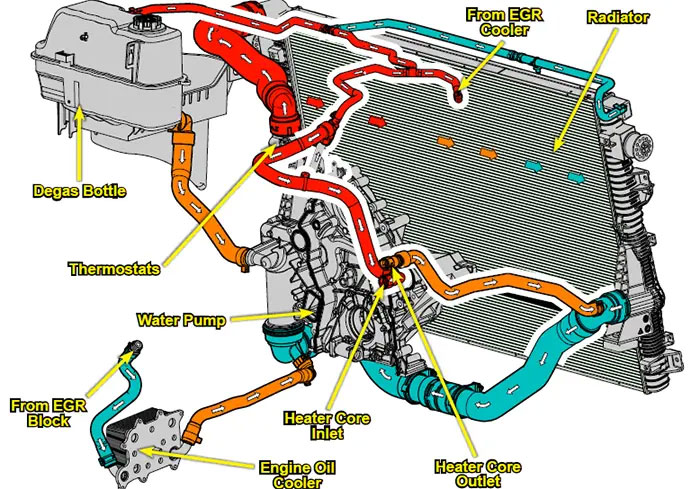
Coolant Circulates Around, Not Through
When people say coolant runs through the EGR valve, they are usually referring to the entire EGR assembly, which often combines the valve and cooler in one unit. Coolant flows through internal jackets or passages in the valve housing, around exhaust gas channels acting like a mini-radiator, and without touching moving components or exhaust flow paths.
This setup allows effective heat transfer while protecting sensitive valve mechanics. On a Chevrolet Cruze Diesel, mechanics report draining residual coolant when removing the EGR valve, which proves that coolant passages exist within the housing.
Integrated Design in Many Models
In many modern engines, the EGR valve and cooler are integrated into a single casting. For example, the Mazda 3 has coolant lines attaching directly to the EGR housing, the Ford 6.0L Power Stroke has the EGR cooler built into the intake manifold, and the VW TDI has the EGR cooler sitting in-line with heater core plumbing.
Because of this integration, disconnecting coolant hoses during EGR service is standard procedure, and skipping it can lead to coolant leaks or air pockets.
Vehicle-Specific EGR Cooling Setups
Common Models and Their Configurations
Several manufacturers use water-cooled EGR systems with varying designs. The Ford 6.0L Power Stroke is infamous for EGR cooler failure due to thermal stress cracking, leading to coolant leaks into exhaust, white smoke, and hydro-lock risk. A telltale sign is a clean or glazed EGR valve instead of a soot-covered one, indicating coolant has been steam cleaning the internals.
The GM Cruze Diesel (1.6L/2.0L) users confirm coolant inside the EGR valve housing during replacement, confirming internal coolant channels exist. Replacement requires new gaskets and careful torque specs to prevent leaks.
Volkswagen TDI models route coolant from engine block to EGR cooler to heater core, meaning removing the EGR cooler breaks the heater circuit and potentially leaves you without cabin heat. Some owners bypass the cooler using a 90° barbed fitting to maintain coolant flow while deleting the component, but improper rerouting risks overheating.
Cummins ISX/X15 engines use a remote-mounted EGR cooler, not integrated into the valve. Still, coolant passes through the cooler, and failure leads to coolant entering exhaust even though physically separated.
Signs of EGR-Related Coolant Leaks
Unexplained Coolant Disappearance
You keep topping off the reservoir but find no leaks under the car, oil looks clean with no milky residue, and there is no overheating yet. This points to internal coolant loss, possibly via EGR cooler.
White Smoke from Exhaust
Persistent steam-like emissions, especially at startup or under load, suggest coolant burning in the exhaust stream. Unlike normal condensation, this smoke smells sweet, does not disappear after warm-up, and may increase under acceleration.
Clean or Glazed EGR Valve
A healthy EGR valve should be covered in black soot. If it is shiny, white or chalky, or has a steam cleaned appearance, it has likely been exposed to coolant, which is strong evidence of internal leakage.
Engine Performance Issues
Coolant in the exhaust or intake can cause rough idle, misfires, and Check Engine Light with codes like P0401 (Insufficient EGR Flow), P0402 (Excessive EGR Flow), or coolant temperature sensor discrepancies.
Risk of Severe Damage
Left unchecked, coolant intrusion can lead to hydro-lock (liquid compression in cylinder), bent rods, cracked heads, and blown head gaskets. Early detection is critical.
Common EGR Cooler Failures
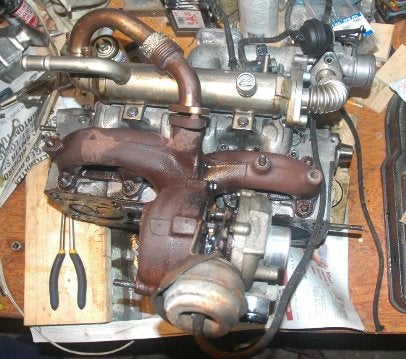
Rupture: Coolant Leaks into Exhaust
Thermal fatigue from repeated heating and cooling causes cracks in coolant tubes. Once breached, coolant enters exhaust flow, white smoke appears, and coolant levels drop steadily. This is most common in Ford 6.0L, GM Cruze Diesel, and older Toyota diesels.
Plugging: Carbon Buildup Blocks Flow
Soot and oil vapors accumulate inside cooler tubes, reducing exhaust gas flow. This leads to poor EGR efficiency, EGR flow codes (P0401/P0402), and increased thermal stress that accelerates cooler failure. This is common in VW/Audi TDI engines due to EGR positioning near the intake.
How to Test for EGR Cooler Leaks
Visual Inspection
Remove the EGR valve and look for moisture or rust inside, white chalky deposits, and evidence of boiling or steaming. A clean valve in a soot-prone engine is a red flag.
Borescope Check
Use a borescope to inspect the intake manifold, exhaust ports, and EGR passages. Look for signs of wetness, residue, or corrosion indicating coolant intrusion.
Cooling System Pressure Test
Pressurize the radiator using a hand pump, watch for pressure drop, and check tailpipe for bubbles, which is a sign coolant is escaping into exhaust.
Block Test (Combustion Leak Test)
This test detects hydrocarbons in coolant, helping distinguish between head gasket failure (hydrocarbons present) and EGR cooler leak (usually no hydrocarbons). If the block test is negative but coolant is disappearing, suspect the EGR cooler.
Submersion Test for Removed Cooler
This is best for confirmed diagnosis. Seal exhaust and coolant ports, pressurize coolant side (5–15 psi), submerge in water, and look for bubbles indicating internal leak. This method is highly effective for pinpointing cracks.
Repairing a Leaking EGR Cooler
Replace the Entire Assembly
Most modern water-cooled EGR units are non-serviceable. You cannot repair the cooler alone; you must replace the whole assembly. The process involves draining coolant, disconnecting electrical connectors and vacuum lines, removing bolts and extracting the unit, installing new gaskets and torquing properly, reconnecting coolant lines, and refilling and bleeding the system.
Labor time is typically 1.5–3 hours, part cost ranges from $150–$400 depending on make, and labor costs $100–$250. Compared to head gasket work, this is a cost-effective fix.
Bleed the Cooling System
Air trapped in the system can cause overheating, loss of cabin heat, and inaccurate temperature readings. Proper bleeding involves starting the engine with the radiator cap off, letting it warm up until the thermostat opens, massaging hoses to release air, adding coolant as the level drops, and rechecking after several drive cycles. Skipping this step risks repeat overheating issues.
Preventing EGR Cooler Failure
Use Proper Coolant
Always use OEM-specified antifreeze, a 50/50 mix of water and ethylene glycol, and corrosion-inhibited formulas like OAT or HOAT. Avoid tap water because it causes scaling and corrosion.
Change Coolant on Schedule
Neglecting coolant changes leads to sludge buildup, corrosion, and reduced heat transfer. Follow manufacturer intervals, typically every 50,000–100,000 miles.
Avoid EGR or DPF Deletion
While some delete the EGR to reduce maintenance, this increases soot and carbon buildup, raises combustion temperatures, and accelerates thermal stress on remaining components. EGR deletion is illegal in most areas, voids warranties, and can fail emissions tests.
Consider a Coolant Catch Can
This reduces contaminants entering the cooling system, especially in turbocharged engines prone to blow-by.
Bypassing the EGR Cooler: Risks and Fixes
Risks of Improper Bypass
Breaking the coolant loop causes air pockets and overheating. No heater core flow results in loss of cabin heat, which is common in VW TDIs. Increased EGTs raise the risk of pre-ignition and valve damage. Emissions violation causes failed inspection and possible fines.
Safe Bypass Method
If you must delete the EGR cooler, use a solid pipe or barbed elbow to reconnect coolant lines, ensure full flow continuity, bleed the system thoroughly, and monitor temperature and heater function. A VW TDI owner replaced the EGR cooler with a 90° barbed fitting from Amazon, reconnecting factory clamps, which resulted in better engine access and no cooling issues because the loop was preserved.
Manufacturer Design Differences
Ford uses an integrated EGR cooler in the 6.0L Power Stroke with a high failure rate prone to cracking. GM uses a water-jacketed design in the Cruze Diesel where coolant in the housing is normal during service. Cummins uses a remote cooler in ISX/X15 engines that still causes coolant loss if failed. VW/Audi TDI engines use a compact inline design susceptible to coking and thermal stress. Toyota diesels like the Land Cruiser use a dual-pass design where high-mileage units often crack.
Frequently Asked Questions About Coolant and the EGR Valve
Does every vehicle have coolant running through the EGR valve?
No, only vehicles with water-cooled EGR systems have coolant running through or around the EGR valve. Older vehicles with air-cooled EGR systems do not use coolant at all in the EGR system.
What happens if the EGR cooler develops a leak?
When the EGR cooler develops a leak, coolant can enter the exhaust stream and be expelled through the tailpipe as white smoke. This causes gradual coolant loss with no visible leaks, potential engine damage from hydro-lock, and possible misdiagnosis as a head gasket failure.
Can I drive with a failing EGR cooler?
It is not recommended to drive with a failing EGR cooler. Continued operation can lead to increased coolant loss, engine overheating, hydro-lock causing catastrophic internal damage, and costly repairs that could have been prevented with early diagnosis.
How do I know if my EGR cooler is failing versus a head gasket problem?
A failing EGR cooler typically shows a clean or glazed EGR valve instead of soot-covered components, no milky oil, and no external coolant leaks. A head gasket failure usually shows milky oil, external coolant leaks, and hydrocarbons present in a block test.
Is it worth replacing the EGR cooler or should I delete it?
Replacing the EGR cooler is the recommended approach. Deleting the EGR cooler is illegal in most areas, voids warranties, increases emissions, and can cause overheating and loss of cabin heat. Replacement costs typically range from $250–$650 including parts and labor.
How often do EGR coolers fail?
EGR cooler failure is most common in high-mileage vehicles, particularly Ford 6.0L Power Stroke engines, GM Cruze Diesels, and VW TDI engines. Failure typically occurs between 80,000–150,000 miles, especially when coolant maintenance has been neglected.
Key Takeaways for EGR Valve and Coolant Systems
Coolant does flow through or around the EGR valve but only in water-cooled systems. The coolant runs through sealed passages in the housing, not the exhaust channel. A failed EGR cooler can leak coolant into the exhaust, causing white smoke and unexplained coolant loss. Symptoms include gradual coolant drop, clean EGR valve appearance, and performance issues. Diagnosis requires pressure testing, visual checks, or block testing to rule out head gasket failure. Repair means replacing the entire EGR assembly and bleeding the cooling system. Deleting the EGR cooler is risky because it can break coolant flow, void warranties, and damage the engine. If modifying, always maintain a continuous coolant loop. Water’s high heat capacity makes it ideal, removing approximately 35 kW of heat in typical operation.
If you suspect an EGR coolant leak, confirm your vehicle has a water-cooled EGR system, inspect the EGR valve for moisture or unusual cleanliness, test the cooling system for hidden leaks, replace the EGR assembly if leakage is confirmed, bleed the system thoroughly after reinstallation, and monitor coolant levels and heater performance. For accurate procedures, always consult OEM service data. Proper EGR cooling system maintenance protects your engine, keeps emissions legal, and prevents catastrophic failure down the road.