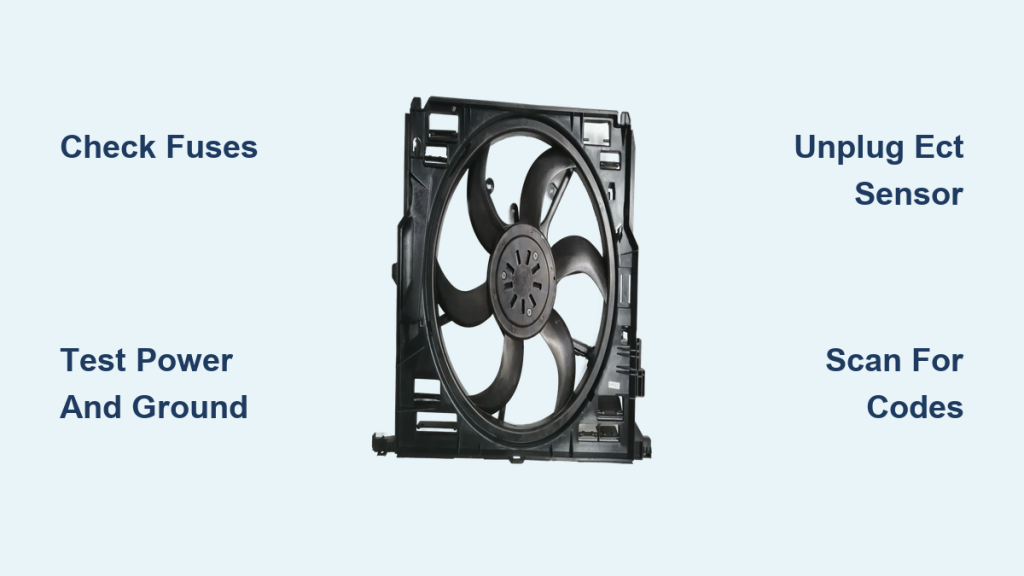
Your BMW starts overheating the moment you hit traffic or idle at a stoplight. A BMW radiator fan not working can quickly lead to engine damage, failed emissions tests, and unexpected roadside breakdowns. Modern BMWs don’t use simple on/off fans like older vehicles. Instead, they rely on smart thermal management that runs the fan at variable speeds between 10% and 100% based on coolant temperature, AC demand, and driving conditions.
Most owners immediately assume the fan motor has died. Real-world data shows the motor itself rarely fails. The actual problem usually sits in the electrical supply, control signal, or sensor inputs. With the right diagnostic approach, you can pinpoint and fix the issue without guesswork or expensive mechanic visits. This guide covers proven testing methods, model-specific quirks, and real fixes used by BMW specialists.
You’ll learn how to:
– Test power, ground, and signal wires with a multimeter
– Force the fan into fail-safe mode to isolate problems
– Diagnose without even starting the engine
– Avoid common traps like chasing relays on 2011+ models
– Check related systems that block fan activation
Start With the Fuses First

Fuses are the fastest and most overlooked fix on any BMW. Even when they look perfectly fine, internal breaks can kill power delivery. On E90 and E92 models, three specific fuses control the entire radiator fan system.
Locate the Critical Fuse Slots
- Slot 92: 60A, the main power supply
- Slot 33: 40A, the secondary fan circuit
- Slot 28: 5A, the control circuit cutout (critical on 2011+ models)
Check your owner’s manual or the underhood diagram to find the correct panel. On most E90s, the panel sits in the engine bay near the battery.
Test Each Fuse With a Multimeter
- Set your multimeter to DC voltage.
- Place the black probe on chassis ground or battery negative.
- Touch the red probe to both sides of each fuse.
A good fuse reads 12 to 13V on both sides. A blown fuse shows voltage on only one side. Even if the 5A fuse in Slot 28 looks intact, test it anyway. On 2011 and newer E90/E92 models, this fuse replaces the physical relay entirely. A blown 5A fuse here stops the control signal, so the fan won’t turn on even when power and ground are perfect.
Pro Tip: Always test fuses under load. A visual check or continuity test can easily miss a failing fuse.
Verify Power and Ground at the Fan Connector
If all fuses check out, move directly to the fan motor connector. This three-wire setup is standard across E9x BMWs.
Identify Each Wire by Color
- Red wire: Constant 13V power from the relay or fuse
- Brown wire: Ground connection to the radiator support beam
- Blue/Black or Black/Blue wire: DME control signal (3 to 4V square wave)
Unplug the connector and grab your multimeter.
Test Each Circuit Individually
Power Test (Red Wire)
Probe the large male pin connected to the red wire. You should read approximately 13V with the key on or off. No voltage means you need to trace back to the fuse or relay.
Ground Test (Brown Wire)
Set your multimeter to continuity mode. Test between the brown wire and battery negative. A good ground beeps immediately at zero ohms. No continuity points to a corroded or loose ground at the crash bar.
Control Signal Test (Blue/Black Wire)
Probe the small pin sitting above the red wire. You should read approximately 3 to 4V as an average of the square wave. Zero volts means the DME isn’t sending signal, or the wire is cut or grounded.
Common Mistake: Assuming power at the fuse means power at the fan. Damaged harnesses frequently break between the fuse box and the motor itself.
Use the ECT Sensor Fail-Safe Test
This is the most powerful diagnostic trick for any BMW radiator fan not working issue.
How Fail-Safe Mode Works
The Engine Coolant Temperature (ECT) sensor tells the DME when to activate the fan. If the sensor fails or disconnects, the DME enters fail-safe mode and runs the fan at 100% speed regardless of temperature.
Perform the Test in Minutes
- Locate the ECT sensor near the thermostat housing.
- Unplug the sensor connector.
- Turn the key to the on position without starting the engine.
- Listen carefully for the radiator fan.
If the fan runs at full speed, the motor, wiring, power, and ground are all good. Your problem lies in the ECT sensor, its wiring, or DME logic. If the fan does not run, the fault sits in the fan circuit, power supply, relay, or ground.
This single test instantly separates sensor issues from electrical faults.
Note: After reconnecting the sensor, clear any codes with a scanner. The check engine light stays on until reset.
Diagnose Control Signal Problems

If the fan runs in fail-safe but not during normal operation, the control signal is broken.
Check the Blue/Black Wire Carefully
With the ECT sensor plugged in and the engine running warm:
- Backprobe the Blue/Black wire at the fan connector.
- Set your multimeter to DC voltage.
- You should read approximately 3 to 4V as an average of the square wave.
No voltage points to several possible causes:
– A cut or grounded control wire
– DME software fault preventing signal output
– Communication error showing as ID 31E9 code
Use a Compatible Scan Tool
A BMW-compatible OBD2 scanner (like Foxwell NT604 or ISTA) lets you:
– Read fault codes including P0117, P0118, P0480, and ID 31E9
– Activate the fan manually through DME commands
– Monitor coolant temperature in real time
ID 31E9 means “Electric Fan, Activation: Line Disconnection.” This code tells you the DME tried to turn on the fan but detected no response, which usually indicates a wiring or fan module issue.
Pro Tip: Run an activation test with the fan unplugged. If voltage appears on the Blue/Black wire, the issue is the fan or its power supply. If no signal appears, the problem sits upstream.
Know Your Model Year: Relay vs. No Relay

A major source of confusion involves the presence or absence of a physical cooling fan relay.
Pre-2011 Models Use a Cut-Off Relay
- Function: Acts as a power switch, not a speed controller
- Location: Behind the passenger-side front wheel well (remove tire and liner)
- How It Works: When triggered by the DME, it sends 13V to the red wire
- Test Method: Listen for a click when the ECT is unplugged, or test voltage at relay output
2011+ Models Have No Physical Relay
- The 5A fuse in Slot 28 acts as the cutout
- Power flows directly when the circuit completes
- Searching for a relay wastes hours because it doesn’t exist
Case Study: A 2011 335i showed ID 31E9 code. The owner spent hours hunting for a relay. Diagnosis revealed damaged wires under the fan connector tape, with no relay involved at all.
Inspect Wiring and Connectors Thoroughly
Many fan failures trace back to hidden wiring damage, especially after front-end collision repairs.
Check the Fan Connector Carefully
- Unplug the connector.
- Remove the electrical tape wrapping the harness.
- Look for these specific issues:
– Frayed or cut wires
– Wires touching each other and grounding
– Corrosion or burnt pins
– Poor splices or aftermarket repairs
The negative brown wire grounds to the radiator support beam. If that mounting bolt is loose or corroded, the ground fails completely.
Look for Post-Collision Damage
After any front impact:
– Wires may get pinched or pulled loose
– Connectors may be improperly reconnected
– Ground points may be forgotten during reassembly
Test continuity from the brown wire all the way to the chassis. Even a few ohms of resistance can stop the fan from running.
Test Ancillary Systems That Block Fan Activation

The radiator fan doesn’t operate in isolation. Two systems can block fan activation even when everything else works perfectly.
Check AC Refrigerant Levels
The fan turns on when the AC requests high pressure cooling. If refrigerant runs low (common due to E90 evaporator core leaks), the AC system shuts down for protection. No AC request means no fan activation in stop-and-go traffic. You’ll notice hot air from the vents combined with overheating at idle.
Fix: Recharge the AC system and repair the leak, usually at the evaporator or Schrader valve.
Test the Electronic Water Pump
On E90 and similar models, the electric water pump circulates coolant throughout the system. If it fails:
– Coolant stops moving
– Engine overheats locally
– Fan may run but cannot cool stagnant fluid
Diagnosis Steps:
– Use a BMW scan tool to activate the pump
– Listen for a whirring sound
– Monitor flow rate in live data
– Look for P0230 or similar codes
Note: Water pumps wear out over time. Intermittent failure is extremely common.
Decode Normal Fan Behavior
Don’t mistake normal operation for a failure.
Fan Runs After Engine Shutdown?
This is completely normal. The DME keeps the fan running for up to 5 minutes after shutdown to manage heat soak. If the fan stops within a few minutes, the system is working correctly.
Fan Only Runs at Low Speed?
This indicates a problem. The fan should ramp from 10% to 100% based on demand. If stuck at low speed:
– Control signal isn’t increasing due to a damaged Blue/Black wire
– DME isn’t commanding higher speeds
– A partial short exists in the harness
Use a scan tool to command 100% speed. If the fan doesn’t respond, the issue sits in the signal or motor.
Step-by-Step Fix Flowchart
Follow this decision tree to fix your BMW fast:
-
Fan not working?
Check fuses in Slots 28, 33, and 92. -
Fuses good?
Test power on the red wire and ground on the brown wire at the fan. -
Power and ground good?
Unplug the ECT sensor. Does the fan run at 100%?
– Yes: Replace the ECT sensor or check its wiring
– No: Check the control signal and harness -
No signal detected?
Use a scan tool to activate the fan manually.
– Signal appears: Fan motor or internal module is bad
– No signal: Check DME communication, wiring, or software -
Still no fix?
Test AC refrigerant levels and the electronic water pump.
Prevent Future Fan Failures
Once you’ve fixed the issue, protect against repeat problems:
– Inspect ground points annually and clean or tighten as needed
– Check AC levels every 2 years since E90s tend to leak over time
– Monitor coolant temperature with a BMW app like Kiwi or Rev
– Address water pump noise immediately, since whining means failure is near
– Use OEM fuses because cheap ones can fail under load
Frequently Asked Questions About BMW Radiator Fan Not Working
Why is my BMW radiator fan not working even though the fuses look fine?
Fuses can have internal breaks that visual inspection misses. Always test with a multimeter under load. On 2011+ E90/E92 models, the 5A fuse in Slot 28 is especially critical because it acts as the control circuit cutout.
How do I know if my BMW radiator fan motor is actually bad?
Use the ECT sensor fail-safe test. Unplug the sensor, turn the key to on, and listen. If the fan runs at 100% speed, the motor is fine and the problem lies elsewhere. If it doesn’t run, the motor or its power supply may be bad.
Where is the BMW E90 radiator fan relay located?
On pre-2011 E90 models, the relay sits behind the passenger-side front wheel well. On 2011 and newer models, there is no physical relay. The 5A fuse in Slot 28 replaces it entirely. Searching for a relay on newer models wastes diagnostic time.
Can low AC refrigerant stop my BMW radiator fan from working?
Yes. The fan activates when the AC system requests high pressure cooling. Low refrigerant (common due to evaporator leaks in E90s) causes the AC to shut down for protection. Without an AC request, the fan won’t activate in stop-and-go traffic.
What does the ID 31E9 fault code mean?
ID 31E9 means “Electric Fan, Activation: Line Disconnection.” The DME tried to turn on the fan but detected no response. This usually points to wiring damage, a disconnected connector, or a faulty fan module rather than a bad motor.
Is it normal for the BMW radiator fan to run after the engine is off?
Yes. The DME keeps the fan running for up to 5 minutes after shutdown to manage heat soak. This is normal thermal management behavior. If the fan stops within a few minutes, the system is working correctly.
Key Takeaways for Fixing Your BMW Radiator Fan
A BMW radiator fan not working is rarely caused by the fan motor itself. Focus your diagnostic efforts on fuses, the 5A cutout in Slot 28, wiring integrity, and the ECT sensor. The fail-safe test splits the problem in half instantly and saves hours of guesswork. With a $20 multimeter and the steps in this guide, you can solve the issue faster than most shops charge for diagnosis. Start with the fuses and work through the flowchart methodically for the fastest path to a working cooling system.