
If your car overheats, one of the first suspects is the coolant pump. But how does a coolant pump work, exactly? It is not just moving fluid. It is the heart of your engine cooling system, ensuring heat from combustion is efficiently transferred away before damage occurs. Without it, even a powerful engine would fail within minutes.
The coolant pump circulates a specially formulated liquid, usually a mix of water and antifreeze, through the engine block, cylinder heads, radiator, and heater core. As the engine runs, it generates immense heat. The coolant absorbs this heat and carries it to the radiator, where it is cooled before being sent back. The pump keeps this loop moving continuously, maintaining a stable operating temperature.
In this guide, you will learn how coolant pumps generate flow, the differences between mechanical and electric types, what makes them fail, and why they are not the same as regular water pumps. You will also discover how modern systems use smart electric pumps to manage heat in hybrids and EVs. Whether you are troubleshooting an overheating issue or just curious about engine mechanics, understanding the coolant pump is key.
Centrifugal Pump Operation Explained

Most coolant pumps use centrifugal force to move fluid. This design is efficient, reliable, and well-suited for continuous circulation in closed-loop systems.
How Centrifugal Force Drives Flow
Coolant enters the pump through the inlet port, directed into the center of a spinning component called the impeller. As the impeller rotates, its curved blades fling the coolant outward with centrifugal force. This increases the fluid kinetic energy, accelerating it radially toward the outer edge.
The high-speed coolant then enters a volute casing, a spiral-shaped chamber that gradually widens. This expansion converts kinetic energy into pressure energy, creating the force needed to push coolant through narrow passages in the engine and radiator.
Key Insight: The pressure difference between the low-pressure inlet and high-pressure outlet is what sustains continuous flow.
Impeller and Volute Design
The impeller and volute work together to generate reliable flow.
- Impeller: Typically made of molded plastic in modern pumps, though older models used steel. Its blade shape and pitch are engineered for optimal flow and pressure.
- Volute Casing: Precision-molded to match impeller dynamics. Even minor cracks or warping can reduce efficiency.
This entire process happens seamlessly as long as the impeller spins. In mechanical pumps, rotation comes from the engine. In electric models, an onboard motor drives it, offering greater control.
Electric vs Mechanical Coolant Pumps
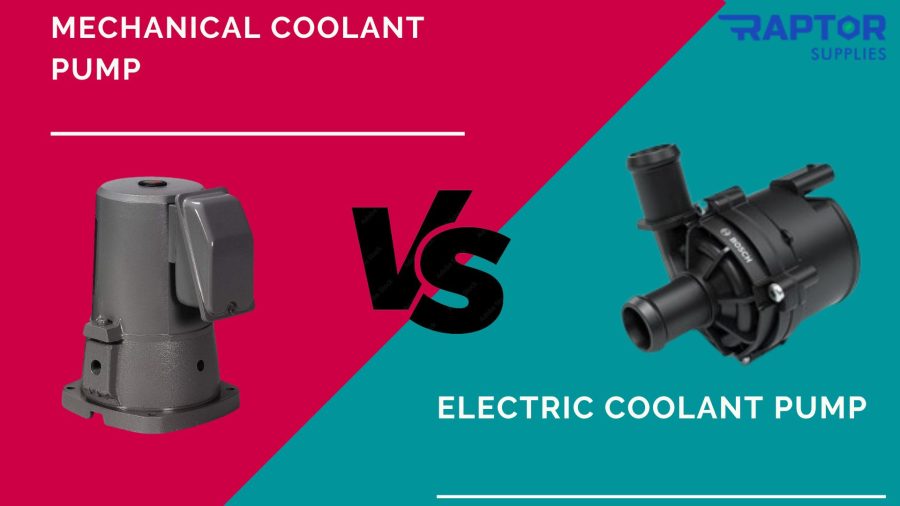
The way a pump is powered determines its performance, efficiency, and application. Today, two main types dominate: mechanical belt-driven and electric.
Mechanical Coolant Pumps
These pumps are driven directly by the engine via a serpentine belt, timing belt, or chain. As the engine spins, so does the pump, typically at a 1:1 ratio, though pulley sizing can adjust speed.
Advantages:
– Proven reliability
– No electrical dependencies
– Low cost
Disadvantages:
– Constant flow regardless of need causes parasitic power loss
– Cannot operate after engine shutdown
– Flow drops at idle, risking overheating
Because they run all the time, mechanical pumps waste energy during warm-up and low-load driving. They also cannot cool components like turbos after the engine stops.
Pro Tip: Replace the coolant pump during timing belt service on interference engines. It is often in the same area and saves labor later.
Electric Coolant Pumps
Electric pumps use a brushless DC motor controlled by the engine control unit. They can vary speed based on real-time conditions like coolant temperature, engine load, and ambient air.
Why They Are Better:
– Variable speed: Only use energy when needed
– Post-shutdown cooling: Prevents turbo heat soak
– Zonal management: Cool batteries, inverters, and motors independently in hybrids and EVs
– No parasitic drag: Improves fuel efficiency
These pumps are common in hybrids like the Lexus RX400h and Toyota Prius, and in EVs like Tesla and BMW i3. Some systems even eliminate thermostats, using the ECU to regulate flow directly.
Example: BMW coolant post-run feature circulates coolant for several minutes after you turn off the car, protecting sensitive turbo components.
Internal Components and Their Roles

Every coolant pump contains the same core parts, each critical to reliable operation.
Housing and Shaft
- Housing: Usually cast aluminum, it contains inlet and outlet ports and mounting flanges. It must withstand thermal cycling and system pressure up to 15 psi.
- Shaft: Connects the drive source to the impeller. Subjected to constant rotation and heat. Failure often starts here.
Bearing and Mechanical Seal
- Bearing: A sealed unit that supports the shaft. Lubricated for life, but can fail due to contamination or overheating.
- Mechanical Seal: Two ultra-flat surfaces, ceramic and metal, pressed together by a spring. A thin film of coolant lubricates them. If this fails, coolant leaks into the bearing area.
Warning: Once the seal fails, the pump must be replaced. No field repairs are possible.
Impeller and Weep Hole
- Impeller: Spins inside the volute, creating flow. Plastic impellers are lightweight but can crack or erode over time.
- Weep Hole: A small drain hole between the seal and bearing. Allows minor seepage to escape safely. Dampness is normal. Steady dripping means the seal is gone.
Coolant Pump Failure Causes and Signs
Even robust pumps fail eventually. Knowing the signs helps prevent engine damage.
Common Failure Modes
| Failure | Cause | Symptom |
|---|---|---|
| Leaking coolant | Failed mechanical seal | Puddles under engine, white crust near weep hole |
| Bearing noise | Contamination or age | Whining, grinding, pulley wobble |
| No flow | Detached or eroded impeller | Overheating, no hose pulsation |
| Corrosion | Old or improper coolant | Pitting, sludge, reduced flow |
| Cavitation | Low coolant or air pockets | Hissing noise, pitting on impeller |
Critical: Stop leak additives should be avoided. They can clog the weep hole, damage bearings, and mask real problems.
Quick Impeller Test
Follow these steps to check pump function:
- Warm engine until thermostat opens, meaning the top radiator hose is hot
- Shut off engine
- Squeeze the upper radiator hose firmly
- Have someone restart the engine briefly
- Feel for pulsation
Pulsation felt means the pump is working. No pulse means the impeller is slipping or broken. This test bypasses thermostat confusion and directly checks pump output.
Coolant Types and Material Compatibility
Coolant pumps handle more than just water. They are built for engineered fluids with specific thermal and chemical properties.
Common Coolant Types
| Fluid | Application | Notes |
|---|---|---|
| Ethylene glycol | Most cars | Freeze protection to -34°C, boil point up to 129°C |
| Propylene glycol | Food, medical | Less toxic. Used in beverage chillers |
| Deionized water | Electronics, data centers | Prevents conductivity and scale |
| Oil-based fluids | Industrial gearboxes | High thermal stability |
| Refrigerants | MRI, HVAC | Used in chiller loops |
Pump materials must resist these fluids. Common choices include stainless steel shafts, EPDM or Viton seals, and polyphenylene sulfide impellers. Using tap water or wrong coolant leads to corrosion, sludge, and premature failure.
Submersible and Positive Displacement Pumps
Not all coolant pumps are centrifugal. Some applications need different designs.
Submersible Pumps
Used in CNC machines, industrial sumps, and machine tools. The pump sits fully submerged in the coolant tank.
Advantages:
– No priming needed
– Less cavitation risk
– Quiet operation
– Easy maintenance
Common in factories where machines run for hours and need constant cooling.
Positive Displacement Pumps
Used in medical devices, lab instruments, and precision cooling.
Types include rotary vane and gear-type pumps. They deliver a fixed volume per revolution, making flow consistent even under pressure changes. Ideal for systems needing exact dosing or stable pressure.
Example: Fluid-o-Tech TMFR 30-200 series for mass spectrometers and incubators.
Applications Beyond Automotive Engines
Coolant pumps are not just for cars. They are vital across industries.
Industrial Machinery
CNC machines generate heat from cutting and friction. Submersible pumps circulate coolant to cool cutting tools, prevent thermal expansion, and extend tool life. Failure means poor surface finish, dimensional inaccuracies, or tool breakage.
Medical Equipment
MRI and CT scanners use pumps to cool superconducting magnets with liquid helium or glycol mixtures. These systems require ultra-reliable operation, low vibration, and quiet performance. A pump failure can shut down an entire imaging suite.
Data Centers and Electronics
High-density servers use liquid cooling loops with pumps to remove heat from CPUs and GPUs. Deionized water or dielectric fluid prevents electrical shorts.
In EVs, multiple electric pumps manage battery temperature, inverter cooling, and motor heat.
Example: Tesla uses zonal cooling with independent pumps for battery and drive units.
Selecting the Right Coolant Pump
Choosing a pump is not just about size. It is about matching system demands.
Key Selection Criteria
| Parameter | Why It Matters |
|---|---|
| Flow rate | Must handle heat load. Too low causes overheating. |
| Pressure | Must overcome resistance in hoses, filters, radiators. |
| Power supply | 12V, 24V, or AC. Must match system. |
| Temperature range | Must work from -30°C to +120°C. |
| Material compatibility | Seals and impeller must resist coolant chemistry. |
| Noise level | Critical in labs, offices, medical rooms. |
| Control interface | PWM, CAN bus, or analog signals for speed control. |
For EVs and hybrids, look for pumps with CAN bus integration for real-time ECU communication.
Maintenance and Replacement Tips
A well-maintained pump lasts longer and prevents costly engine damage.
When to Replace
- Mechanical pumps: Every 60,000 to 100,000 miles
- Electric pumps: Up to 10 years, but electronics can fail earlier
Best Practices
- Replace with timing belt when accessible
- Use OEM or high-quality aftermarket. Cheap pumps fail fast.
- Torque bolts correctly. Over-tightening cracks aluminum housings.
- Use correct gasket or sealant. Follow service manual.
- Flush system before installing new pump.
Coolant Service Intervals
| Coolant Type | Change Interval |
|---|---|
| IAT Green | Every 2 years or 30,000 miles |
| OAT Orange | 5 years or 150,000 miles |
| HOAT Yellow | 5 years or 100,000 miles |
Old coolant turns acidic, corrodes parts, and reduces heat transfer.
Advanced Thermal Management Systems
Modern vehicles use multi-pump setups for smarter cooling.
Multi-Zone Cooling
Instead of one pump for the engine, EVs and hybrids use a primary pump for the engine or main loop and auxiliary pumps for battery, power electronics, and cabin heating. Each runs independently, optimizing efficiency and response.
Example: BMW i-series uses separate pumps for battery pack and motor cooling, allowing preconditioning while parked.
Smart Control Features
- Post-run cooling: Keeps circulating after shutdown
- Cold start optimization: Delays flow to warm engine faster
- Load-based modulation: Increases flow under acceleration
These features improve efficiency, reduce emissions, and extend component life.
Leading Manufacturers and Models
Not all pumps are equal. Top brands focus on reliability and precision.
Fluid-o-Tech
Specializes in high-tech pumps for medical and lab use.
- TMCF01S-07S: 220V AC, for beverage dispensers and cold rooms
- TMFR 30-200: Quiet, reliable, used in mass spectrometers
Grundfos
Industrial leader with SPK series pumps for boilers, washing machines, and cooling circuits. Available in multiple voltages and configurations.
Final Thoughts on Coolant Pump Operation
The coolant pump is far more than a simple circulator. It is a precision component critical to thermal stability, efficiency, and longevity. Whether mechanical or electric, its job is to keep systems running at peak temperature.
Key takeaways include understanding that centrifugal force drives flow in most pumps, mechanical pumps offer simplicity while electric pumps provide precision control, and failure signs like leaks, noise, and overheating require immediate attention. Proper coolant maintenance and timely replacement prevent costly engine damage.
Understanding how a coolant pump works helps you diagnose issues early, choose the right replacement, and maintain optimal performance across vehicles, machines, and high-tech equipment.
Frequently Asked Questions About Coolant Pumps
What is the main function of a coolant pump?
The coolant pump circulates coolant through the engine block, radiator, and heater core. It absorbs heat from the engine and transfers it to the radiator for dissipation, maintaining optimal operating temperature.
How do I know if my coolant pump is failing?
Common signs include coolant leaks under the engine, whining or grinding noises, overheating during normal operation, and no pulsation felt when squeezing the upper radiator hose during the impeller test.
Can I use a water pump instead of a coolant pump?
No. Coolant pumps are designed for recirculation in closed-loop systems with chemically treated coolants. Water pumps are designed for open transfer and cannot handle the additive packages in modern coolants.
How long does a coolant pump last?
Mechanical pumps typically last 60,000 to 100,000 miles. Electric pumps can last up to 10 years but may fail earlier due to electronic issues.
Why are electric coolant pumps better than mechanical ones?
Electric pumps offer variable speed control, can run after engine shutdown to prevent turbo heat soak, reduce parasitic power loss, and enable zonal thermal management in hybrid and electric vehicles.
What causes coolant pump failure?
Common causes include failed mechanical seals, bearing wear from contamination or age, corrosion from old or improper coolant, cavitation from low coolant levels, and plastic impeller damage from thermal stress or chemical degradation.