You’re driving along when suddenly the check engine light flashes with code P0301. You pull over, check under the hood, and notice your coolant reservoir is nearly empty. No visible leaks. No overheating. But now you’re wondering: could low coolant cause a misfire? The short answer is nuanced. Low coolant by itself won’t directly trigger a misfire, but the underlying reason for that low level very well might.
This article breaks down exactly how coolant system failures indirectly cause engine misfires. You’ll learn the technical mechanisms, diagnostic clues, proven testing methods, and real-world case studies that show when low coolant is actually a warning sign of a much deeper mechanical problem.
Why Low Coolant Itself Won’t Directly Cause a Misfire
A misfire occurs when one or more cylinders fail to combust fuel properly. Common causes include bad spark plugs, faulty ignition coils, fuel injector issues, or vacuum leaks. But coolant-related misfires are a different beast because they stem from internal engine damage, not ignition or fuel delivery problems.
The key distinction is straightforward:
- Low coolant due to external leak or evaporation does NOT cause misfire
- Internal coolant leakage into a combustion chamber DOES cause misfire
When coolant enters the combustion chamber through a failing head gasket, cracked cylinder head, or degraded intake manifold gasket, it disrupts ignition, causes hydrolock, and leads to repeated misfires, especially at startup.
How Coolant Intrusion Triggers Misfires: 4 Technical Mechanisms

Coolant doesn’t belong in the combustion chamber. When it gets there through an internal leak, it interferes with combustion in multiple ways:
Hydrolock at Startup: Liquid coolant cannot be compressed. During the compression stroke, the piston meets resistance from the incompressible fluid, causing incomplete cycle and immediate misfire. This often happens only at cold start when coolant has pooled overnight.
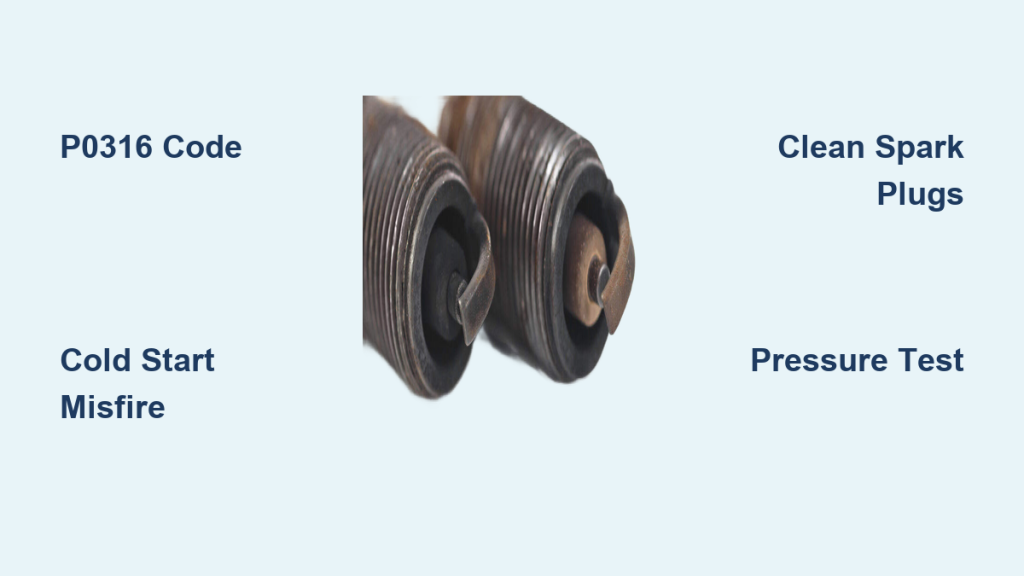
Spark Plug Wetting: Coolant coats the spark plug electrode, preventing proper arcing. This results in no ignition and a cylinder-specific misfire. Spark plugs from affected cylinders will appear clean, white, or chalky rather than having normal carbon deposits.
Intake Valve Contamination: Coolant leaking into the intake port pools on closed valves. At startup, the valve opens and draws coolant into the cylinder, causing hydrolock or incomplete combustion.
Combustion Chamber Dilution: Even small amounts of coolant vapor can alter the air-fuel ratio and quench the flame front. This causes partial burns, rough idle, and misfire under load.
Decoding P0316: The Startup Misfire Code
One of the most telling signs of coolant-related misfire is DTC P0316, which means “Misfire Detected During First 1,000 Revolutions at Startup.” This code is a red flag for pressure-dependent fluid intrusion, especially when paired with gradual coolant loss with no external leak and misfire that clears after the engine runs for 30 seconds.
At startup, any coolant that has pooled in a cylinder overnight gets compressed. Since liquids don’t compress, the piston cannot complete its stroke, causing immediate misfire. Once the engine runs and warms up, the coolant burns off or drains, and compression returns to normal. This pattern is classic for failing head gaskets, cracked cylinder heads, and degraded intake manifold gaskets.
If P0316 appears with a cylinder-specific code like P0301, focus your diagnostics on that specific cylinder, especially its proximity to coolant passages.
Real-World Case Study: Ford Triton V8 Misfire
A 2003 Ford F-150 with the 4.6L Triton V8 came in with P0301 and P0316 codes. The truck showed slow coolant loss with no visible external leaks, cold-start misfire on Cylinder 1 that disappeared after warm-up, and no milky oil.
The diagnosis revealed the issue clearly. The cooling system was pressurized to 15 psi while monitoring live cylinder contribution data. The scan showed severe contribution loss in Cylinder 1 only under pressure. When depressurized, the misfire vanished immediately.
Borescope inspection revealed coolant residue on the intake valve of Cylinder 1. The root cause was a micro-leak in the intake manifold gasket allowing coolant to seep into the cylinder’s intake port under system pressure.
Triton engines are particularly prone to this issue because the aluminum intake manifold expands and contracts with heat cycles, the single-piece rubber gasket degrades over time typically between 80,000 and 150,000 miles, and coolant flows through the intake, so gasket failure can route coolant directly into intake ports.
Diagnosing Coolant-Related Misfire: 5 Proven Tests

When dealing with potential coolant-related misfires, these diagnostic procedures will help identify the root cause:
Pressure Test with Live Scan: Pressurize the cooling system to 15 psi while monitoring cylinder contribution with a scan tool. If the misfire appears only under pressure, you have internal leak. Release pressure and if the misfire stops, you’ve confirmed the issue.
Block Test (Combustion Gas Sniffer): Use hydrocarbon-detecting fluid over the radiator neck when the engine is warm but not boiling. A color change from blue to yellow or green indicates exhaust gases in the coolant, confirming head gasket failure.
Borescope Inspection: Remove the spark plug from the misfiring cylinder and insert a borescope. Look for coolant droplets, sheen on the piston, or residue on the valves.
Spark Plug Check: Remove and examine plugs from misfiring cylinders. Coolant exposure signs include clean white or chalky insulator, eroded or pitted electrodes, and absence of normal carbon buildup.
Coolant Analysis: Test for hydrocarbons in the coolant using chemical strips or lab analysis. Check for bubbles in the overflow tank while the engine runs, which indicates exhaust gas in the cooling system.
Common Misconceptions About Coolant and Misfires
Several myths persist about the relationship between coolant and engine misfires that lead to misdiagnosis:
“No Milky Oil Means No Head Gasket Problem”: False. Many head gasket failures route coolant only into combustion chambers or exhaust, completely bypassing oil passages. You can have severe coolant intrusion with perfectly clean oil.
“Low Coolant Can’t Cause Misfire”: Misleading. The coolant level itself isn’t the issue. The cause of the low coolant is what matters. Internal leakage absolutely causes misfire risk.
“Only Overheating Causes Head Gasket Failure”: False. Thermal cycling, improper torque, age, and design flaws can cause failure without any overheating event.
“Aluminum Heads Don’t Crack”: False. Aluminum is actually more prone to warping and micro-cracks under thermal stress than cast iron.
High-Risk Engines for Coolant-Related Misfires
Certain engines are more susceptible to coolant intrusion issues that cause misfires. These include the Ford 4.6L and 5.4L Triton V8, BMW M52 and S52 engines, GM LS-family engines with plastic intakes, and Mini Cooper S engines that have experienced overheating.
If you own one of these vehicles and notice unexplained coolant loss paired with misfires, prioritize testing for internal coolant leakage before replacing ignition components.
Repair Strategies to Prevent Catastrophic Damage
Addressing coolant-related misfires requires fixing the root cause, not just the symptoms. Here are the critical steps:
Immediate Actions: Don’t ignore startup misfires because they’re often early warnings of internal damage. Test before replacing parts. Swapping coils or spark plugs won’t fix a leaking head gasket. Inspect intake manifold gaskets on high-risk engines.
Long-Term Risks of Delay: Ignoring these symptoms can lead to catalytic converter damage from raw fuel and coolant byproducts, O2 sensor poisoning from coolant combustion products, bent connecting rods from repeated hydrolock, and complete engine failure if coolant enters the oil passages.
Upgrade for Durability: Use MLS (multi-layer steel) head gaskets or reinforced intake gaskets. Replace all fasteners per manufacturer specification. Follow the exact torque sequence during reassembly. Don’t reuse old bolts on critical gaskets.
Frequently Asked Questions About Low Coolant and Misfires
Can low coolant level alone cause a misfire?
No. Low coolant level from external leaks or evaporation won’t directly cause a misfire. However, if that low level is due to internal coolant leakage into combustion chambers, then yes, it absolutely can cause misfires through hydrolock or spark plug wetting.
What is the most common sign of coolant-related misfire?
P0316 (misfire during first 1,000 revolutions at startup) combined with unexplained coolant loss is the strongest indicator. The misfire typically clears after the engine warms up, which suggests coolant is being burned off or draining from the cylinder.
Do I need milky oil to have a head gasket problem causing misfire?
No. Many head gasket failures route coolant only into combustion chambers or exhaust passages, completely bypassing oil passages. You can have a severe head gasket leak with perfectly clean oil and no milky residue.
Can adding water to coolant cause misfire?
Clean water mixed properly won’t directly cause misfire. However, contaminated tap water with minerals can cause corrosion and scale buildup in aluminum engines, leading to overheating and eventual head gasket failure, which can then cause coolant intrusion and misfire.
How do I know if my misfire is caused by coolant and not ignition problems?
Check your spark plugs. If they appear clean, white, or chalky rather than having normal carbon buildup, coolant is likely wetting the plugs. Also monitor whether the misfire only occurs at cold startup and disappears after warm-up, which is classic for coolant-related hydrolock.
Key Takeaways for Diagnosing Coolant-Related Misfires
Low coolant itself won’t trigger a misfire, but internal coolant leakage into combustion chambers definitely will through hydrolock, spark plug wetting, or combustion dilution. Watch for P0316 combined with unexplained coolant loss, misfire that clears after warm-up, and clean white spark plugs from the affected cylinder.
Treat any unexplained coolant consumption paired with misfire symptoms as a serious warning sign. Early diagnosis with a pressure test, block test, or borescope inspection can save you from catastrophic engine failure. Fix the root cause, whether it’s a failing head gasket, cracked head, or degraded intake manifold gasket, before coolant destroys your catalytic converter, O2 sensors, or engine internals.
Your engine needs clean, contained coolant. Once it enters the wrong compartment, misfires are just the beginning of much larger problems.