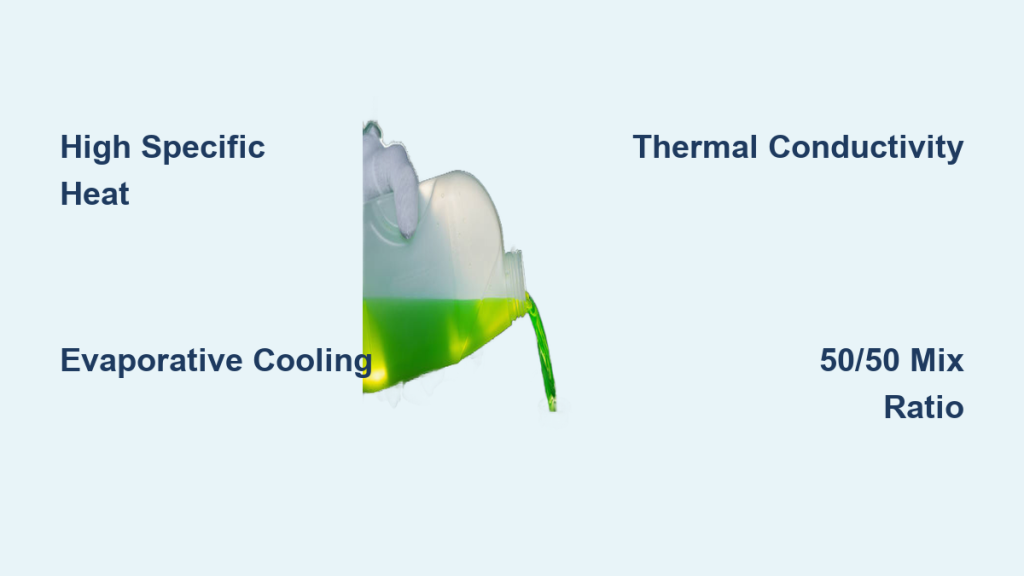
You’re driving on a hot summer day, engine humming under the hood. Without something to absorb and carry away heat, that engine would overheat in minutes. The unsung hero keeping it cool? Water—one of the most effective and widely used coolants across industries, from cars to power plants to the human body.
But how does water act as a coolant so effectively? It’s not just about being liquid—it’s about what kind of liquid water is. Thanks to its unique molecular structure and exceptional thermophysical properties, water absorbs large amounts of heat with minimal temperature rise, transfers that heat efficiently, and releases it safely. In fact, no other common fluid matches water’s natural ability to stabilize temperatures in high-heat environments.
Key Properties That Make Water an Effective Coolant
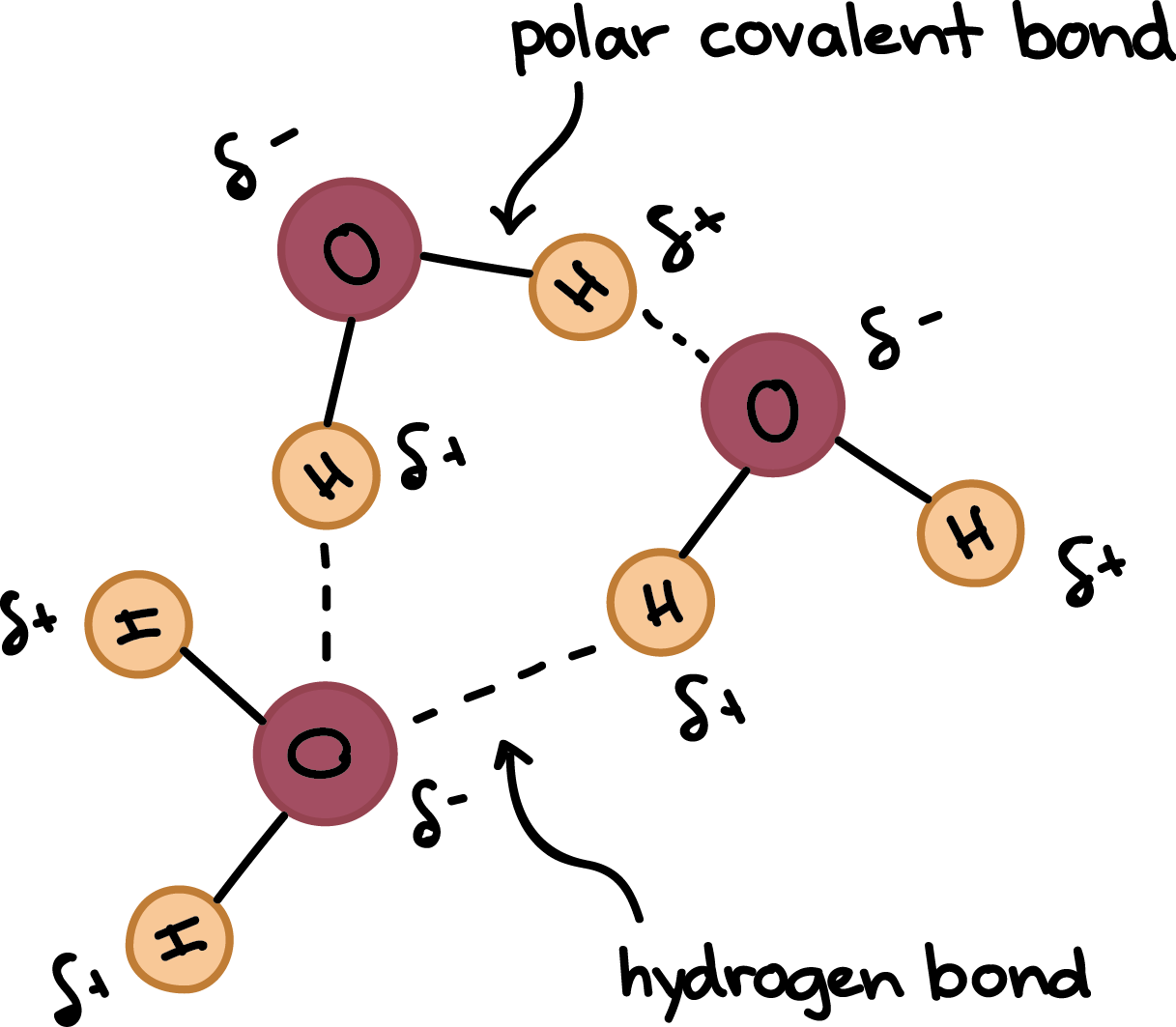
Water doesn’t just happen to be a good coolant—it’s engineered by nature to excel at heat management. Its molecular polarity and hydrogen bonding create a set of physical traits unmatched by synthetic alternatives.
High Specific Heat Capacity Explained
Water can absorb 4.184 joules per gram per degree Celsius—more than almost any common liquid. That means it takes a lot of energy to raise its temperature, making it a powerful thermal buffer.
In practical terms:
• A liter of water absorbs nearly twice as much heat as the same volume of ethylene glycol before warming up
• In engines, this smooths out temperature spikes during acceleration or heavy load
• In industrial processes, it reduces thermal cycling that stresses equipment
This stability comes from hydrogen bonds between water molecules. Energy goes into breaking these bonds before molecules move faster, allowing water to store more thermal energy without a sharp rise in temperature.
Why Thermal Conductivity Matters
At 0.6 W/m·K, water conducts heat better than most liquids. This allows rapid transfer from hot metal surfaces like engine blocks or reactor walls into the coolant stream.
High conductivity ensures:
• Faster heat pickup at the source
• Reduced risk of localized hot spots
• Uniform cooling across large components
Without this, even a high-heat-capacity fluid would lag in response, creating dangerous thermal gradients.
The Power of Evaporative Cooling
When water boils, it absorbs 2260 kJ/kg of energy without increasing in temperature. This phase change is the secret behind evaporative cooling.
Applications leveraging this include:
• Cooling towers in power plants
• Human sweating
• Some high-performance electronics cooling
While boiling is avoided in closed-loop engine systems, controlled evaporation dramatically boosts heat removal in open systems.
Flow Efficiency Through Low Viscosity
Water flows easily through narrow channels—radiator fins, micro-cooling loops, or blood capillaries—thanks to its low resistance to movement.
Benefits include:
• Less pumping power required
• Better circulation in complex geometries
• Enhanced convective heat transfer
Even small increases in viscosity reduce flow and efficiency, which is why water-based mixtures dominate cooling applications.
Why Pure Water Is Not Used Alone in Cooling Systems
Despite its superior thermal properties, pure water has critical weaknesses that prevent standalone use in most systems. Left unmodified, it can damage engines, freeze in winter, or boil under load.
The Boiling Point Problem
At standard pressure, water boils at 100°C (212°F)—a threshold easily crossed in engines and machinery. Once boiling begins:
• Steam bubbles form on hot surfaces
• These vapor pockets act as insulators
• Metal temperatures spike rapidly
Even a brief loss of liquid contact can lead to localized overheating and warping.
Fix: Pressurized cooling systems. A typical 15 psi radiator cap raises the boiling point to ~121°C (250°F), giving a safer margin.
Freezing Damage in Cold Climates
Water expands 9% when freezing. In cold climates, this can:
• Crack aluminum engine blocks
• Burst radiators and heater cores
• Destroy water pumps
A frozen cooling system often means costly repairs before the vehicle even starts.
Fix: Add antifreeze (ethylene or propylene glycol) to depress the freezing point.
Corrosion Threat to Metal Components
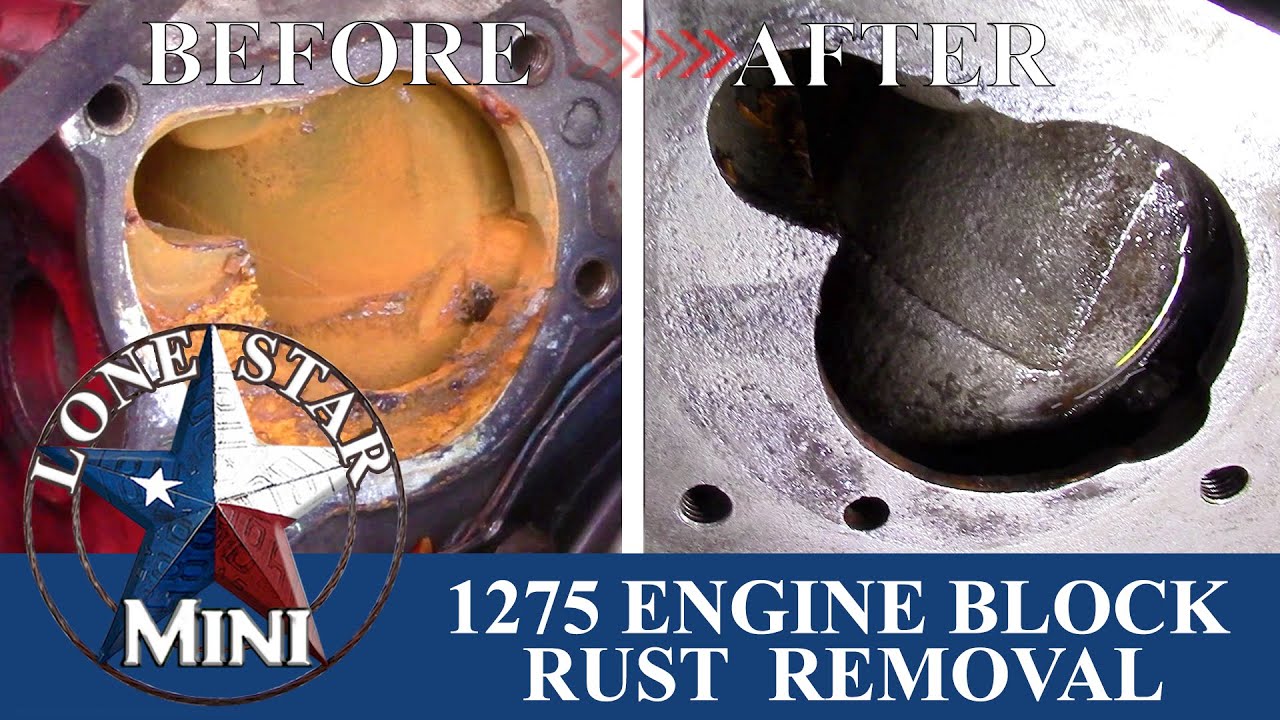
Even deionized water reacts electrochemically with iron, aluminum, copper, and steel. Dissolved oxygen accelerates:
• Rust formation
• Galvanic corrosion between dissimilar metals
• Pitting and erosion in pumps and radiators
Over time, corroded surfaces reduce heat transfer and clog passages.
Visual clue: Rust-colored coolant or pitted impeller blades indicate active corrosion.
Scale Buildup Reducing Efficiency
Tap or well water contains calcium and magnesium. When heated, these minerals precipitate as limescale, coating internal surfaces.
Scale problems include:
• Acts as a thermal insulator like a blanket on a radiator
• Narrows coolant channels
• Promotes hot spots and overheating
Hard water areas see rapid buildup, shortening system life.
Solution: Use distilled or deionized water in mixtures.
Electrical Conductivity Risks in Electronics
Impure water conducts electricity, posing a hazard in electronic cooling. A leak could short-circuit servers or GPUs.
Fix: Use deionized water, which has minimal ions and very low conductivity—ideal for data center cooling loops.
How Coolant Mixtures Improve Water’s Performance

To get the best of both worlds—water’s heat capacity and added protection—engineers blend it with additives. The result is coolants that perform under real-world stress.
The 50/50 Water-Glycol Mix Standard
A balanced blend of 50% water and 50% ethylene glycol delivers:
• Freeze protection down to -37°C (-34°F)
• Boiling point of ~129°C (265°F) at atmospheric pressure
• Over 135°C (275°F) when pressurized
• High specific heat (~3.3 J/g·°C)—still far better than pure glycol
This mix is the recommended standard for year-round automotive use.
Why Not Use More Glycol
Beyond 70%, heat capacity drops sharply:
• Pure ethylene glycol: only ~2.4 J/g·°C
• Higher viscosity reduces flow
• Less efficient heat removal
Too much glycol sacrifices cooling performance for freeze protection.
Corrosion Inhibitors Essential Additives
Modern coolants contain chemical packages (OAT, HOAT, IAT) that:
• Form protective films on metal surfaces
• Neutralize acids
• Extend system life
These inhibitors are why coolant lasts 3–5 years instead of months.
Surfactants and Water Wetter Products
Products like Water Wetter contain surfactants that lower surface tension, improving:
• Surface wetting on hot metals
• Nucleate boiling efficiency
• Heat transfer rate
Used in racing and high-performance engines, they help prevent hot spots and cavitation.
Deionized Water for Specialized Systems
In electronics, racing, or lab equipment:
• Deionized or distilled water prevents scaling and conductivity issues
• Still requires corrosion inhibitors for long-term use
• Offers maximum heat transfer with minimal risk
Common in direct-to-chip cooling and immersion setups where purity matters.
Waterless Coolants for Niche Applications
Formulations without water (e.g., Evans High-Performance Coolant):
• Boil above 188°C (370°F)
• Never freeze
• Eliminate steam pockets and pressure caps
But drawbacks exist:
• Lower specific heat
• Higher cost
• Not ideal for everyday vehicles
Best suited for extreme environments or vintage cars stored in cold climates.
Real-World Applications of Water Cooling
Water’s cooling power spans industries—from your car to nuclear reactors. Here’s how it works in practice.
Automotive Cooling Systems Explained
In vehicles, coolant flows through:
1. Engine block and head – absorbs heat from combustion
2. Thermostat – regulates flow based on temperature
3. Radiator – releases heat via airflow
4. Water pump – circulates the loop
Common mistakes to avoid:
• Using tap water alone leads to scale and rust
• Draining antifreeze in summer removes corrosion protection
• Mixing coolant types can cause gel formation and clogs
Ideal mix by climate:
| Climate | Recommended Ratio | Purpose |
|---|---|---|
| Hot (Arizona, Texas) | 70% water / 30% coolant | Max heat transfer |
| Cold (Montana, Canada) | 70% coolant / 30% water | Freeze protection |
| Moderate | 50/50 | Balanced performance |
Manufacturers like Ford recommend 40–60% glycol for optimal function.
Industrial and Power Generation Cooling
Cooling towers use evaporative cooling, leveraging water’s high latent heat to reject waste heat. Nuclear reactors use light water (H₂O) as both coolant and neutron moderator. Machining operations use water-soluble coolants (oil-in-water emulsions) to cool tools and flush debris.
In all cases, water’s efficiency reduces energy costs and improves process control.
Electronics and Data Center Cooling
High-density computing generates intense heat. Air cooling struggles—so water steps in.
Cooling methods include:
• Closed-loop coolers (AIOs) – pump water near CPU/GPU
• Direct-to-chip cooling – deionized water flows through microchannels
• Rear-door heat exchangers – cool server racks with water-cooled panels
Water removes heat up to 3,500x more efficiently than air, enabling higher performance with lower energy use.
Racing and Extreme Environment Cooling
Some racing series ban glycol-based coolant to prevent slippery track surfaces if leaks occur. Teams use:
• Pure water + surfactants (e.g., Water Wetter)
• Deionized water with anti-corrosion additives
• Short-duration runs to avoid boiling
Rocket engines use liquid hydrogen not just as fuel, but as a regenerative coolant, circulating it through nozzles to absorb heat before combustion.
Biological Cooling: Water in the Human Body
Nature uses water for thermal regulation too. In mammals:
• Blood (mostly water) carries heat from core organs to skin
• Sweat evaporates from the skin surface
• Each gram of sweat removes 2.26 kJ of heat via latent heat of vaporization
This natural evaporative system keeps body temperature within a narrow 36.5–37.5°C range—even during intense exercise or in hot climates.
It’s a real-world proof of concept: water’s cooling power works even in living systems.
Nanofluids: Next-Gen Water Cooling Technology
Scientists are enhancing water with nanoparticles to push performance further.
Types and benefits:
| Nanoparticle | Concentration | Improvement |
|---|---|---|
| Silver nanorods | 0.5 vol.% | +68% thermal conductivity in water |
| Alumina | 0.1% | +70% critical heat flux |
| Carbon nanotubes | Low % | Improved nucleate boiling |
These nanofluids enhance heat transfer at the microscopic level by:
• Increasing surface area for heat exchange
• Promoting faster bubble detachment
• Altering fluid dynamics near hot surfaces
But challenges remain:
• Particles may settle or clog microchannels
• High concentrations (>5%) make fluids non-Newtonian (harder to pump)
• Long-term stability and cost are concerns
Still, nanofluids show promise for next-gen data centers, electric vehicles, and aerospace cooling.
Best Practices for Water-Based Cooling Systems
Follow these steps to maximize efficiency and lifespan.
Step 1: Never Use Tap Water Alone
Minerals in tap water cause:
• Scale buildup
• Electrolytic corrosion
• Reduced heat transfer
Use distilled or deionized water when mixing or topping off.
Step 2: Maintain Proper Glycol Ratio
Stick to 50/50 unless climate demands adjustment. Avoid exceeding 70% glycol—it harms heat capacity.
Use a coolant tester or refractometer to check concentration.
Step 3: Replace Coolant on Schedule
Most last 2–5 years or 150,000 miles. Old coolant:
• Loses corrosion inhibitors
• Turns acidic
• Forms sludge
Signs of failure:
• Rusty or milky fluid
• Low pH (<7.5)
• Overheating despite full reservoir
Step 4: Flush the System Regularly
Every 3–5 years, flush to remove:
• Rust particles
• Scale deposits
• Degraded additives
Prevents clogs and restores cooling efficiency.
Step 5: Check Radiator Cap Pressure
A faulty cap cannot maintain pressure, lowering the boiling point. Test or replace every 5 years.
Step 6: Match Coolant Type to Vehicle
Use the correct chemistry:
• OAT (Organic Acid Technology) – long-life, orange/red
• HOAT (Hybrid OAT) – yellow/green, common in Fords and Chryslers
• IAT (Inorganic) – traditional green, for older vehicles
Mixing types can reduce effectiveness.
Key Takeaways for Understanding How Water Acts as a Coolant
How does water act as a coolant? By combining unmatched thermophysical properties with practical availability, it absorbs, transports, and dissipates heat more efficiently than nearly any other substance.
But pure water is not enough. Its low boiling point, freezing risk, and corrosiveness require enhancement through:
• Glycol additives for freeze and boil protection
• Corrosion inhibitors for longevity
• Deionized water in sensitive applications
The 50/50 water-glycol mix remains the gold standard—balancing performance, protection, and cost.
Essential tips to remember:
• Water is the base, not the complete solution
• Always use distilled water in mixtures
• Never run plain tap water long-term
• Monitor coolant level, color, and pH
• Flush and replace on schedule
From your car engine to the human body, water is the original and still the best coolant—when used wisely. The future may bring nanofluids or waterless formulas, but for now, the secret to cool performance is simple: water, enhanced.
Frequently Asked Questions About Water as a Coolant
Why is water better than other liquids for cooling?
Water has a higher specific heat capacity than most common liquids, meaning it can absorb more heat without a significant temperature increase. Its high thermal conductivity allows rapid heat transfer, and its high latent heat of vaporization makes it exceptionally effective in evaporative cooling applications.
Can I use plain water in my car radiator?
Using plain water is not recommended for long-term use. While water has excellent cooling properties, plain water causes corrosion, forms scale, and has a low boiling point. For reliable protection, use a proper water-glycol coolant mixture.
What is the best water-to-glycol ratio for cooling?
The 50/50 mixture is the standard recommendation for most climates. This provides freeze protection down to -37°C (-34°F), a boiling point around 129°C (265°F), and optimal heat transfer. Adjust ratios slightly for extreme hot or cold climates.
How does water cool an engine without boiling?
In closed-loop cooling systems, water circulates continuously without boiling. The system stays under pressure (typically 15 psi), which raises the boiling point to around 121°C (250°F). Heat is dissipated through the radiator before the coolant reaches boiling temperature.
Does water cooling work for electronics?
Yes, water cooling is widely used in electronics. Deionized water is preferred because it lacks ions that conduct electricity. Direct-to-chip cooling and closed-loop systems are common in high-performance computing, offering heat removal up to 3,500 times more efficient than air cooling.