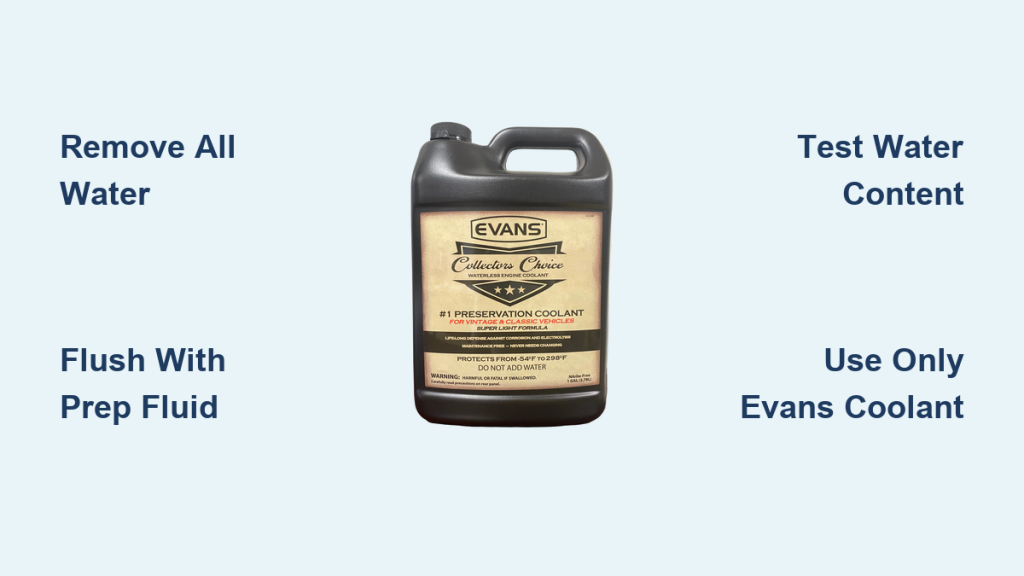
If your engine regularly runs hot, suffers from corrosion, or demands frequent coolant changes, Evans waterless coolant offers a revolutionary solution. Designed to eliminate water-related failures, this non-aqueous coolant prevents boil-over, corrosion, and pressure spikes by operating without water. With a boiling point above 375°F and freeze protection down to -40°F, it is trusted in race cars, vintage vehicles, diesel trucks, and marine engines. But to unlock its full benefits, correct installation is critical, especially removing all water before filling. This guide walks you through every step of using Evans waterless coolant, from system prep to final verification, ensuring your engine gains maximum protection and longevity.
Convert Properly: Remove All Water First

Evans coolant only works when water content is below 3 percent. Any more, and the system risks steam formation, pressure buildup, and corrosion. Unlike traditional antifreeze, you cannot just drain the radiator and top off. You must completely purge old coolant and trapped water from every part of the system.
Drain the Entire Cooling System
Start by draining fluid from all access points, not just the radiator. Use bullet points to identify all drain locations:
• Radiator petcock or drain plug
• Engine block drain plugs
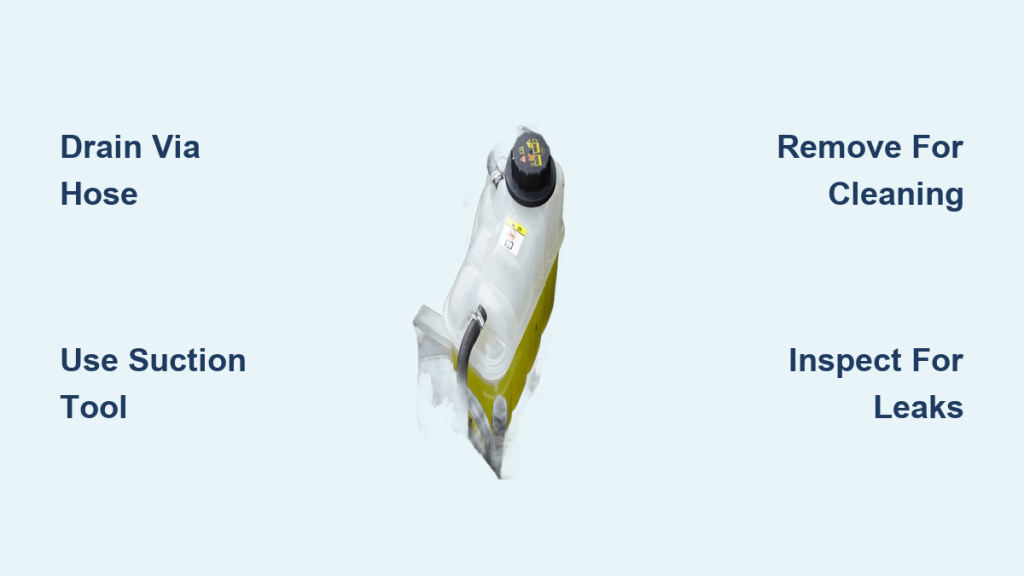
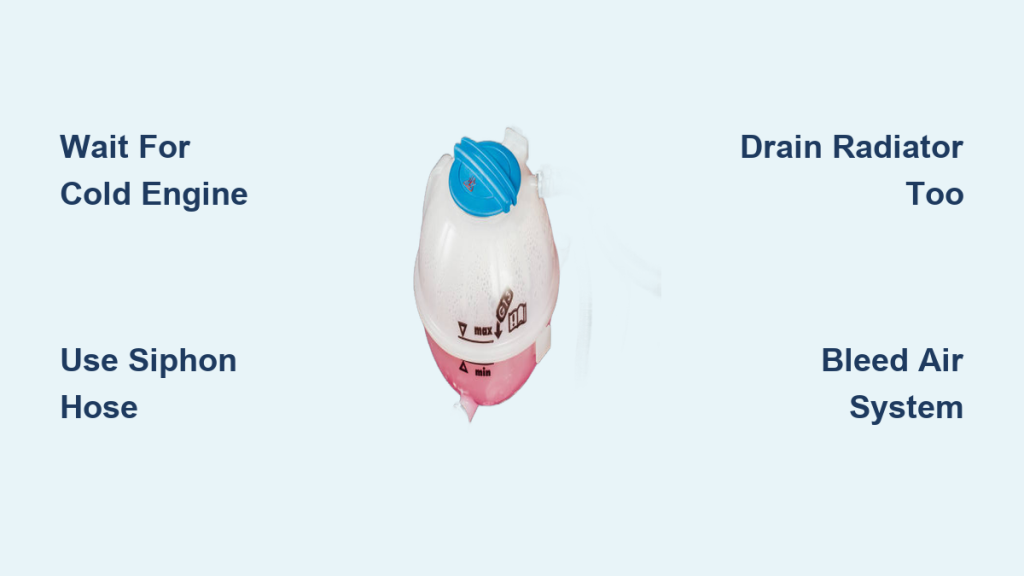
• Coolant reservoir or overflow tank
• Heater core
• Thermostat housing
• Oil cooler if coolant-cooled
Draining only the radiator removes less than half of total system fluid. The engine block holds the rest.
Blow Out Residual Coolant
Use high-volume, low-pressure air between 30 and 50 psi to force out trapped fluid. Apply air through the top radiator hose or heater inlet. Direct flow from cylinder head to water pump inlet to push coolant out. Open the heater valve to clear the heater core.
For engines without block drains, remove the thermostat to allow air to pass through the block. Blow air in until only mist, then dry air, exits the lower hose.
Flush with Evans Prep Fluid
Even after draining, microscopic water remains. Evans Prep Fluid is a hydroscopic solvent that pulls out residual moisture and contaminants.
Circulate Prep Fluid Properly
Follow these numbered steps exactly:
- Close all drains and reconnect hoses.
- Fill system completely with Evans Prep Fluid. Never use water.
- Install a non-SCA coolant filter if applicable.
- Vent air from high points during fill.
- Replace radiator cap.
- Start engine and run to full operating temperature.
- Run for 10 to 15 minutes with heater on full hot.
- Shut off and let cool completely.
- Drain Prep Fluid from all points.
- Blow out again with air.
Prep Fluid should remain clear amber. Cloudiness means old coolant or sludge. Repeat flush if needed.
Prep Fluid is reusable. Strain and store used fluid in a sealed container for multiple vehicles.
Fill with Evans Waterless Coolant
Now that the system is dry and clean, install the final product.
Add Pure Evans Coolant
Follow these steps:
- Ensure all drain plugs are tight and hoses secure.
- Fill entire system with Evans High Performance Waterless Coolant.
- Start engine and let it warm up.
- Run for 10 to 20 minutes after thermostat opens, heater on full hot.
- Shut off and allow to cool completely.
Air pockets escape during this cycle. Do not overfill.
Test Water Content Below 3 Percent
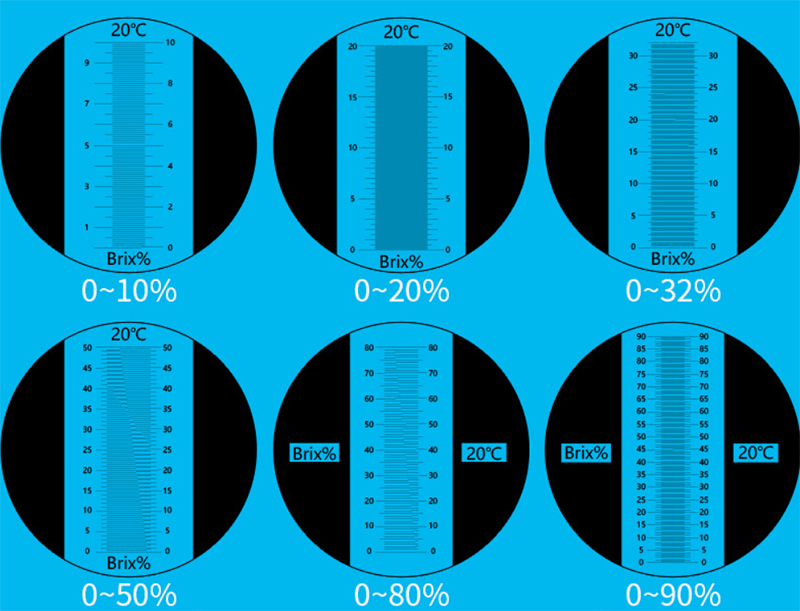
This is the most critical step. If water exceeds 3 percent, Evans protection fails.
Sample Coolant Correctly
Draw sample from radiator or expansion tank. Coolant must be at room temperature. Minimize air exposure during sampling.
Use Refractometer or Test Strips
For refractometer, calibrate with distilled water first. Place 2 to 3 drops of coolant on the prism. Read Brix value: 55.5 Brix equals 0.3 percent water, well within safe range.
For test strips, dip into coolant and compare color to chart. Should show near 0 percent water.
If water exceeds 3 percent, run engine again to operating temperature to evaporate more water. Cool and retest. Still high? Repeat Prep Fluid flush or extend air purge time.
Finalize Installation
Once water levels are confirmed safe, complete the setup.
Top Off Expansion Tank
Fill overflow bottle to the cold fill line with Evans coolant only. Do not use water or mixed antifreeze. Check level after 2 to 3 cold starts and add more if needed as air fully evacuates.
Apply Warning Stickers
Evans includes warning labels. Place them on the radiator cap, radiator shroud, overflow tank, and expansion tank. Accidental water addition contaminates the system and voids protection.
Label System Clearly
Mark the system with waterless coolant do not add water. This prevents misfills during service or emergencies.
Understand Temperature Behavior
Gauge Reads Higher: It Is Normal
After conversion, your dashboard temperature gauge may read higher than before. This is expected, not a problem. Evans coolant absorbs more heat from the engine, so the coolant runs hotter. But the engine block runs cooler. Verify with an infrared thermometer. No action needed. Do not install a colder thermostat or modify the system.
Maintain Zero Maintenance
One of the biggest advantages? No more coolant changes.
Long-Term Care
No coolant replacement is ever needed. It is a lifetime coolant. No SCAs, extenders, or additives are needed. Top off only with Evans coolant if level drops, which indicates a leak. No winterizing is required. It freezes to -40°F or lower. Safe in storage with no corrosion during long-term inactivity.
Ensure Compatibility and Safety
Works With All Major Engine Types
Evans coolant is safe and effective for gasoline engines, diesel engines, marine engines, off-road and overlanding rigs, racing applications, and antique and vintage vehicles.
Radiator Cap: Keep the Original
No need to replace your 15 to 18 psi radiator cap. Evans operates safely in both pressurized and non-pressurized systems. Minimal vapor pressure means less stress on hoses and gaskets.
Troubleshoot Common Issues
High Temp Gauge
Cause is normal coolant temperature rise. Confirm engine block temp with IR gun. No action needed.
Coolant Level Drops After Fill
Cause is air pockets escaping during first few cycles. Top off with Evans coolant when engine is cold.
Water Content Stays Above 3 Percent
Cause is incomplete drainage or residual moisture. Fix by repeating Prep Fluid flush and air blow-out. Extend engine run time.
Overheating After Install
Cause is water contamination or air lock. Test water content. Bleed system thoroughly. Never add water.
Leaks Appear After Conversion
Cause is thermal changes exposing pre-existing weak points. Inspect hoses, gaskets, radiator, and water pump. Repair before continuing.
Follow Best Practices
Do and Do Not
Do use Evans Prep Fluid for flushing. Do test water with refractometer. Do top off with Evans coolant only. Do keep conversion records. Do reuse filtered Prep Fluid.
Do not use water, alcohol, or generic flush. Do not guess or skip testing. Do not add water or green antifreeze. Do not assume good enough without verification. Do not leave Prep Fluid exposed to air or moisture.
Safety First
Wear gloves and eye protection. Work in a well-ventilated area. Never open a hot radiator cap. Wait until engine is cool. Dispose of old coolant responsibly at a recycling center.
Never use Evans in a leaking system. Repair leaks before conversion.
Real-World Benefits Confirmed
Proven in Extreme Conditions
Flathead Fords experience fewer head gasket failures due to reduced cylinder pressure. Diesel pullers maintain more consistent performance under load. Marine applications show no corrosion after years in saltwater. Great Race vintage cars complete cross-country runs without overheating.
User Benefits
Water pumps last longer due to no cavitation from steam bubbles. Radiators stay cleaner with no scale or sludge buildup. Engines run smoother under load with stable thermal management. Ideal for storage with no internal rust during months of inactivity.
Get Support and Order Supplies
Need Help
Call 888-990-2665 for technical support. Refer to the Evans General Installation Manual. Order online through Evans website, Eastwood, and select auto retailers.
Product Info
Evans High Performance Waterless Coolant comes in 1 gallon at $57.95. Variants include Diesel, NPG, and Prep Fluid. Warranty provides lifetime cooling system protection when installed correctly.
Frequently Asked Questions About Evans Waterless Coolant
Can I Use Evans Coolant in Any Engine Type?
Yes. Evans waterless coolant works in gasoline engines, light and heavy-duty diesel engines, marine engines, off-road vehicles, racing applications, and antique or vintage vehicles. It is NHRA-approved for motorsports.
Why Does My Temperature Gauge Read Higher After Installation?
This is normal. Evans coolant absorbs more heat from the engine, so the coolant itself runs hotter. However, the engine block actually runs cooler. Verify with an infrared thermometer. Do not modify the cooling system.
How Often Do I Need to Change Evans Coolant?
Never. Evans waterless coolant is a lifetime product. No coolant changes are required. Simply top off with Evans coolant if the level drops due to a leak.
What Happens If Water Enters the System?
Water contamination above 3 percent compromises the boiling point and corrosion protection. If water exceeds 3 percent, repeat the Prep Fluid flush and air purge. Always use only Evans coolant for top-offs.
Do I Need to Replace My Radiator Cap?
No. Evans coolant operates safely with existing 15 to 18 psi radiator caps. It works in both pressurized and non-pressurized systems.
Is Evans Coolant Safe for Long-Term Storage?
Yes. Without water, there is no corrosion or degradation during storage. The coolant remains stable and protective during months or years of inactivity.
Key Takeaways for Using Evans Waterless Coolant
Evans waterless coolant eliminates water-related failures including boil-over, corrosion, and pressure spikes by operating without water. The conversion process requires complete water removal through draining, air purging, and flushing with Prep Fluid. Always verify water content is below 3 percent using a refractometer or test strips before finalizing installation. Once properly installed, Evans provides lifetime maintenance-free cooling protection ideal for extreme conditions, vintage vehicles, racing, and marine applications.